The Word That Costs Buyers Thousands: Reconditioned Audi Q3 Engines and What They Secretly Hide from You
- June 29, 2026
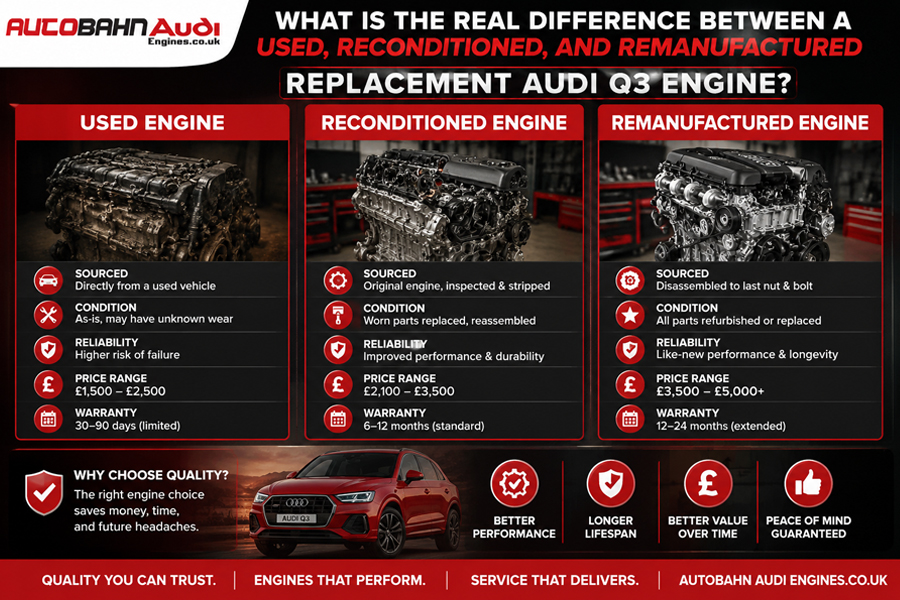
Don't Scrap Your Car Just Yet: The Real Definition That Protects Your Wallet When Buying a Replacement Engine
Quick Answer: What is the Safest Way to Buy a Replacement Audi Q3 Engine?
When your vehicle faces terminal failure, purchasing a legally protected remanufactured engine is the safest option. Unlike a standard reconditioned Audi Q3 engine or a basic rebuilt Audi Q3 engine, a remanufactured unit is completely stripped down to the bare block and engineered back to original factory specifications using brand-new components. This completely eliminates the structural risks, lack of accountability, and short-term lifespans typically associated with a cheap used engine or unverified third-party workshop builds.
The moment an independent garage delivers the verdict that your engine is 'gone', a distinct sense of financial dread sets in. For most premium crossover owners, a major mechanical failure triggers a stressful rush into an unregulated aftermarket full of confusing terminology. You aren't just facing a massive repair bill; you are stepping directly into a linguistic trap engineered by salvage yards, brokers, and independent mechanics who use vague words to keep you from knowing exactly what you are paying for. If you make a choice based on bad information, you could easily end up making a 1,000+ GBP mistake that ruins your car's resale value and leaves you stranded.
Replacement Audi Q3 Engine Cost Summary
|
Engine Tier |
Average UK Cost (Supply Only) |
Realistic Lifespan |
Warranty Coverage |
Risk Level |
|
Used Engine (Salvage) |
£1,200 - £2,000 |
Unknown |
30 - 90 Days (Parts Only) |
High |
|
Reconditioned / Rebuilt |
£2,200 - £3,500 |
30,000 - 50,000 Miles |
6 - 12 Months (Basic) |
Medium |
|
Remanufactured (Factory-Grade) |
£3,800 - £5,500 |
100,000+ Miles |
12 - 24 Months (Comprehensive) |
Low |
What Does Engine Failure Actually Mean for Your Replacement Audi Q3 Engine - and What Are Your Real Options?
Engine failure does not mean every single component under your bonnet has turned to scrap; rather, it means a critical structural component has failed beyond the point of a simple, cost-effective external repair. In a workshop, a professional diagnosis requires a systematic routine: a cylinder compression test to locate pressure losses, a cylinder leakage test to find weak seals, and a digital borescope inspection to look for internal scoring on the cylinder walls. If your mechanic finds deep scoring, a cracked block, or serious crankshaft damage, the labour costs to fix it piece by piece will quickly exceed the value of the car. At this stage, your only realistic choices are to scrap the vehicle for a minimal payout or invest in a replacement engine to restore your car's value.
Many mechanics declare an engine completely 'dead' simply because they lack the high-end precision machinery needed to rebuild it themselves, or because they want to make a quick profit margin by sourcing a cheap scrap unit and charging you full price for the installation.
What Is the Real Difference Between a Used, Reconditioned, and Remanufactured Replacement Audi Q3 Engine?
The automotive aftermarket relies heavily on confusing language to prevent direct price comparisons and keep buyers in the dark. In the UK, there is no strict legal definition for a reconditioned Audi Q3 engine or a rebuilt Audi Q3 engine, which means a seller can clean the outside of an engine, replace a single gasket, and legally sell it under those titles. A remanufactured unit, however, must follow strict British Standards (BS AU 257a), requiring the engine to be completely disassembled, measured against original factory tolerances, and rebuilt with brand-new wear parts.
Detailed Component Comparison Table
|
Engineering Operation |
Used Engine (Salvage Yard) |
Reconditioned / Rebuilt Engine |
Remanufactured Engine (BS AU 257a) |
|
Piston Rings & Bearings |
Original (Worn) |
Checked visually; replaced only if completely failed |
Always replaced with brand-new components |
|
Crankshaft Journals |
Original |
Polished loosely |
Ground and measured to +/-0.0025mm tolerance |
|
Cylinder Bore Treatment |
None (Glazed) |
Light glaze breaking glaze |
Precision honed or re-bored to oversized specs |
|
Cylinder Head Testing |
None |
Visual check only |
Pressure tested for micro-cracks and skimmed |
Brokers frequently buy high-mileage units from crash-damaged cars, spray-paint the blocks to make them look clean, and sell them online as 'fully reconditioned' without ever opening up the crankcase to inspect the internal bearings.
What Are the Known Failure Points of the CHPB, CZEA, and CZDA Engine That Every Buyer Must Know Before Purchasing a Reconditioned Audi Q3 Engine?
If you are buying a replacement unit for a first or second-generation Audi Q3, you must understand the specific engineering weaknesses of the 1.4-litre and 1.5-litre TFSI families. The CHPB, CZEA, and CZDA engines are all built on the EA211 modular platform, which uses a lightweight aluminium block with thin iron cylinder liners. A major known issue across these codes is high oil consumption caused by carbon buildup on the oil control rings, which eventually leads to oil starvation and scored cylinder walls. Furthermore, variants equipped with Cylinder on Demand (CoD) technology—such as the CZEA engine—suffer from premature wear on the camshaft actuators, which can cause timing synchronization failures and catastrophic valve-to-piston contact.
Component Entity Map
- Engine Code: CHPB (1.4 TFSI) Chassis Association: Audi Q3 8U (2013-2015) Ancillary Risk: High carbon loading on intake valves and turbocharger wastegate rattle.
- Engine Code: CZEA (1.4 TFSI CoD) Chassis Association: Audi Q3 8U Facelift (2015-2018) Ancillary Risk: Actuator pin wear within the cylinder head assembly causing top-end noise.
- Engine Code: CZDA (1.4 TFSI) Chassis Association: Audi Q3 Premium Markets Ancillary Risk: Early water pump housing distortion leading to sudden coolant loss.
if you buy a standard second-hand or poorly rebuilt unit without verified, updated piston rings, the engine will likely start burning oil at an alarming rate within the first 3,000 miles of driving.
Is a Rebuilt Audi Q3 Engine ULEZ Compliant and What Does UK Law Actually Protect You With?
Yes, a replacement unit will maintain your car's original Ultra Low Emission Zone (ULEZ) status, provided the engine code matches your original V5C registration document exactly. Under the UK Consumer Rights Act 2015, any engine supplied and fitted by a commercial garage must be of 'satisfactory quality', 'fit for purpose', and 'as described'. However, if you purchase a cheap reconditioned engine cost option from an online broker and bring it to a separate garage for fitting, you divide the legal liability. If the engine fails, the supplier will blame the installer, the installer will blame the supplier, and you will be left stuck in the middle without a working car.
If an engine swap changes your vehicle's emissions output or core identity, you are legally required to notify the DVLA via an updated V5C form, along with an engineer's report, to keep your insurance policy valid.
What Are the Timing Belt and Camshaft Issues That Afflict a Used Audi Q3 Engine After Installation?
The EA211 engine series (CHPB, CZDA, CZEA) moved away from the problematic timing chains of older Audi models and switched to a hybrid belt-in-oil system or a long-life dry timing belt. While this change made the engine run quieter, it introduced a new risk: the tensioners and idler pulleys are prone to premature micro-seizures. When you buy a standard used engine from a scrap vehicle that has been sitting idle in a yard, moisture builds up inside these bearings. Once the engine is started and run at normal operating temperatures, the dry bearings can lock up, causing the belt to snap instantly and destroy the cylinder head.
What most independent garages won't tell you is that they will often reuse the timing belt kit and water pump from a donor engine to keep their quote low, rather than installing the mandatory new components required to safeguard your investment.
Will Buying a Cheap Replacement Audi Q3 Engine Cause Your Vehicle to Fail the New UK MOT Emissions Tests?
High-efficiency, direct-injection engines like the Audi 1.4 TFSI rely on very precise fuel atomisation to pass the strict UK MOT smoke and emissions tests. When an engine has worn valve stem seals or oval-shaped cylinder bores—common issues in unverified reconditioned engine cost listings—oil leaks directly into the combustion chamber. This oil contamination poisons the catalytic converter and clogs the Petrol Particulate Filter (PPF). This leads to elevated hydrocarbon (HC) and carbon monoxide (CO) readings at the exhaust tailpipe, resulting in an automatic MOT failure that can cost thousands of pounds to fix.
Worn engine can easily pass a basic workshop rev test but will instantly fail the sophisticated, real-time gas analysis performed during an official DVSA MOT evaluation.
Explore More About Audi Engine
- 1 UK Pricing Guide: What You'll Pay for a Reconditioned Audi Q3 Engine
- 2 Beyond Repair? Exploring Rebuilt & Used Engine Options for Your Audi Q3
- 3 Reconditioned Audi Q3 Engine: Full Cost Breakdown for Supply, Fitting & Replacement
- 4 Reconditioned vs Used Audi Q5: Why Reconditioned Wins Based on UK Repair Data
- 5 Supply and Fitting” For Audi Q3 Engine – The Hidden Liability Handshake They Want You to Sign
People Also Ask (FAQ)
What is the exact cylinder bore wear limit for the Audi CZEA engine block?
The maximum allowable service limit for cylinder bore ovality and taper on the Audi CZEA aluminium block is exactly $0.08 If measurements exceed this threshold, the block must be machined to accept oversized pistons or fitted with new liners to prevent piston slap and high oil consumption.
Can you skim the cylinder head on a CHPB engine during a rebuild?
No, Audi's official workshop guidelines state that the cylinder head on the 1.4 TFSI CHPB engine cannot be skimmed or machined. Because the valve tolerances and timing gear geometry are so precise, any reduction in head height can lead to dangerous valve-to-piston clearance issues.
What torque specification is required for the main crankshaft bearings on a CZDA engine?
The main bearing bolts on the CZDA engine require a dual-stage torque sequence: first torque them to $50 and then turn them an additional $90These are stretch bolts (yield fasteners) and must always be replaced with brand-new ones during a rebuild.
How do I know if a seller is offering a genuine remanufactured engine?
A genuine remanufacturer will always provide a written certificate confirming compliance with British Standard BS AU 257a. They will also provide a clear breakdown of the brand-new internal components installed and offer a parts-and-labour warranty that is valid at any VAT-registered workshop across the UK.
Why do reconditioned Audi Q3 engines suffer from early oil pressure drops?
Early oil pressure failure is usually caused by worn variable-displacement oil pump control valves, or by using cheap, non-specification silicone sealant on the oil sump. This excess sealant breaks off internally and blocks the oil pickup strainer pipe.
Does a replacement engine come with a new turbocharger and fuel injectors?
No, standard replacement units are typically sold as a 'bare long engine', which consists of the cylinder block, cylinder head, oil pan, and internal timing gear. Your existing turbocharger, fuel injectors, alternator, and starter motor are transferred over from your old unit.
How long does a garage take to complete an Audi Q3 engine supply and fit?
A professional engine swap typically takes between 12 and 18 hours of book-time labour, which translates to 2 to 3 working days in a properly equipped workshop. Any garage claiming they can complete the entire job in just a few hours is likely rushing through essential torque checks and diagnostic calibrations.
If your Audi Q3 is currently sitting disabled in a workshop, don't let yourself be rushed into buying a cheap, high-risk scrap unit or an unverified rebuild. Contact our technical team today to receive a transparent, fixed-price quote for a precision-engineered, factory-standard remanufactured engine built to solve your car's underlying design faults for good.

